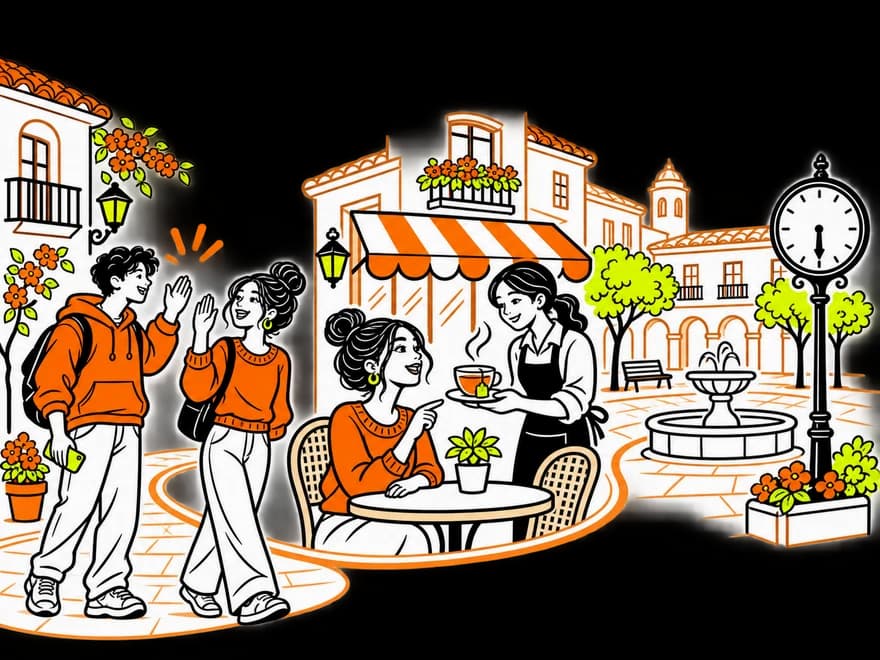
Start with one situation
Look at the setting before reading the Spanish. Try to follow the whole exchange, then open the translation and notes. Repeat a difficult line on its own and return to the complete conversation. Choosing one scene is enough for a short session; the three scenes are not a required sequence for three consecutive days.
The examples use everyday Spanish with situations set in Spain. Learn useful phrases such as ¿Cómo te llamas? as a whole before trying to explain every word. Later, changing one familiar detail can help you use the phrase beyond the script.
1. Meeting someone new
Ana and Leo have just met. Ana asks his name and where he is from; Leo returns the question. Notice who is from each city.
Hola, soy Ana. ¿Cómo te llamas?
Me llamo Leo. Mucho gusto.
¿De dónde eres?
Soy de Sevilla. ¿Y tú?
Soy de Madrid.
TranslationTranslation
Hi, I’m Ana. What’s your name?
My name is Leo. Nice to meet you.
Where are you from?
I’m from Seville. And you?
I’m from Madrid.
Soy de Sevilla gives Leo’s origin; it does not necessarily describe his current location. ¿Y tú? passes the same question back. Ana answers about Madrid. Mucho gusto is a greeting when meeting someone, not an answer about where they live.
2. Ordering at a café
A customer orders tea. The server checks whether they want milk, brings the drink and gives the price. The two euros belong to this scene, not to a real café price list.
Hola. Un té, por favor.
¿Con leche o sin leche?
Sin leche, gracias.
Aquí tiene.
Gracias. ¿Cuánto es?
Dos euros.
TranslationTranslation
Hello. A tea, please.
With milk or without milk?
Without milk, thanks.
Here you are.
Thank you. How much is it?
Two euros.
Con leche / sin leche means with/without milk. Aquí tiene is a polite way to address one customer using usted. The customer’s ¿Cuánto es? asks for the price. Keep por favor and gracias: they are part of a useful request, not extra decoration.
3. Arranging to meet
Ana suggests meeting the next day. Leo asks the time, and Ana adds the place. They finish with a goodbye that refers to tomorrow.
¿Quedamos mañana?
Sí. ¿A qué hora?
A las seis, en la plaza.
Perfecto. Hasta mañana.
TranslationTranslation
Shall we meet tomorrow?
Yes. What time?
At six, in the square.
Perfect. See you tomorrow.
¿A qué hora? asks about the time; a las seis answers it. En la plaza adds the place. Here quedamos means arranging to meet, a common use in Spain. Learn Hasta mañana as “See you tomorrow,” rather than translating each word separately.
Three small changes to check your understanding
These are exercises for this article. Complete each one, then open its explanation. They are separate from recording the original script for an IDVI group task.
1. Give Leo a different city
Leo is from Valencia in this version. Complete his reply: Soy ___ Valencia. ¿Y tú?
Show answerHide answer
Soy de Valencia. ¿Y tú?
“I’m from Valencia. And you?” Keep de before the city. You have changed the origin, not the person’s current location.
2. Order a different drink
You want coffee with milk. What do you say to order, and how do you answer ¿Con leche o sin leche??
Show answerHide answer
One possible answer: Un café, por favor. Con leche, gracias.
“A coffee, please. With milk, thanks.” The drink changes from té to café, and sin changes to con. These two short lines complete the request in this scene.
3. Move the meeting
The friends will meet at seven in the same square. Replace the time in A las seis, en la plaza.
Show answerHide answer
A las siete, en la plaza.
“At seven, in the square.” Only the time changes. Mañana and the location remain the same; no new day or place is needed.
From reading to a short recording
Choose the scene you can understand without guessing. Say every Spanish line in order, leaving a small pause when the speaker changes. You can use the text while preparing. If this is your group’s IDVI task, learn both parts of the original dialogue, record yourself saying them from memory and share the video in the group; changing the script or waiting for a partner is not required.
Listen for the detail that makes the exchange work: the city, the choice of milk, or the time. A group member can support the recording with a reply or reaction. A like is encouragement, not confirmation that every phrase is correct.
For other uses of these verbs, read ser vs. estar. To ask whether a place exists nearby and then find it, try hay and estar. Continue through the Spanish learning materials.
Sources
The dialogues, translations and exercises are original IDVI teaching material. Their role in the course is explained in how the program is built. The three scenes are a selection, not a complete A1 course.

Who are you?
Reviewed by Yulia Romanova
English and Spanish teacher ·