Method
How learning works in IDVI Language
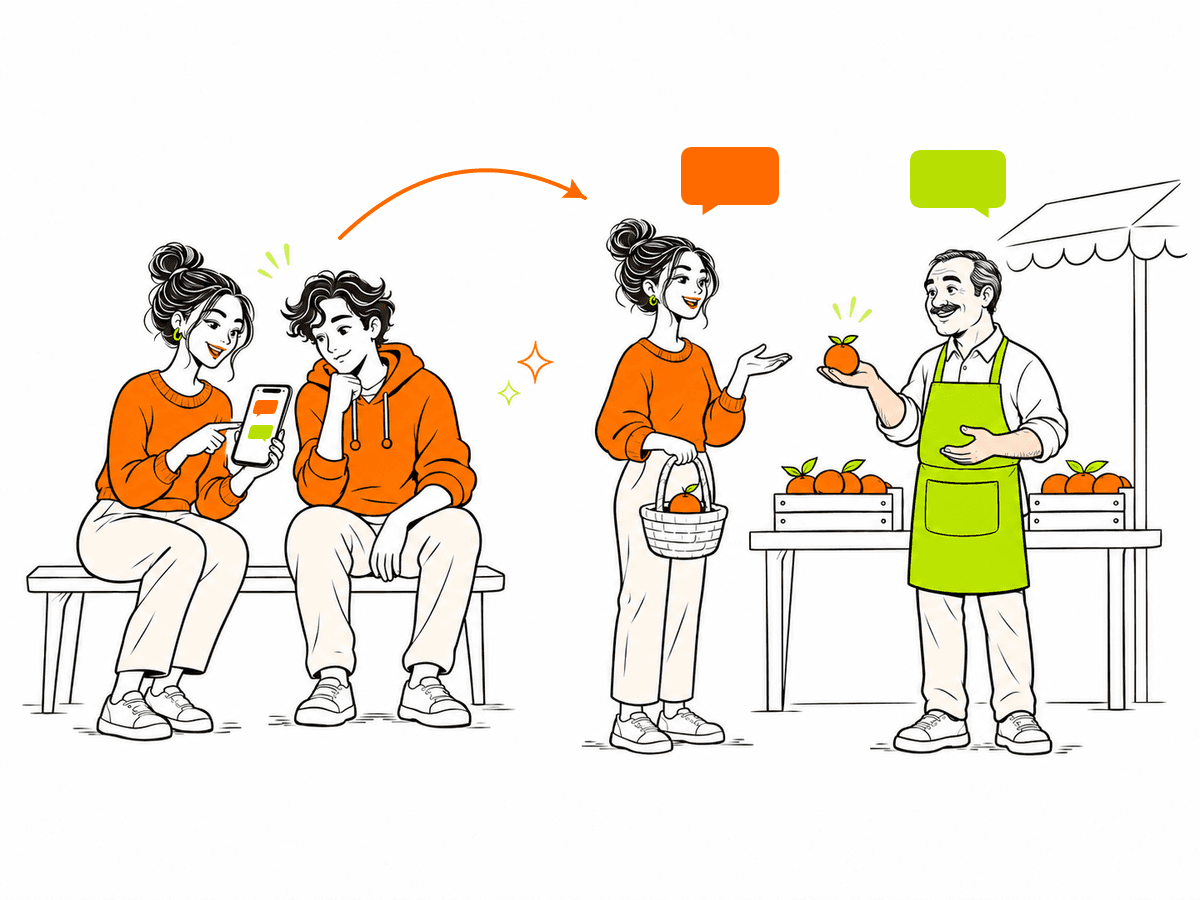
IDVIIn our experience, participants in IDVI groups began communicating in the language they were learning in everyday situations after about a month - for example, in shops, pharmacies or on the street.
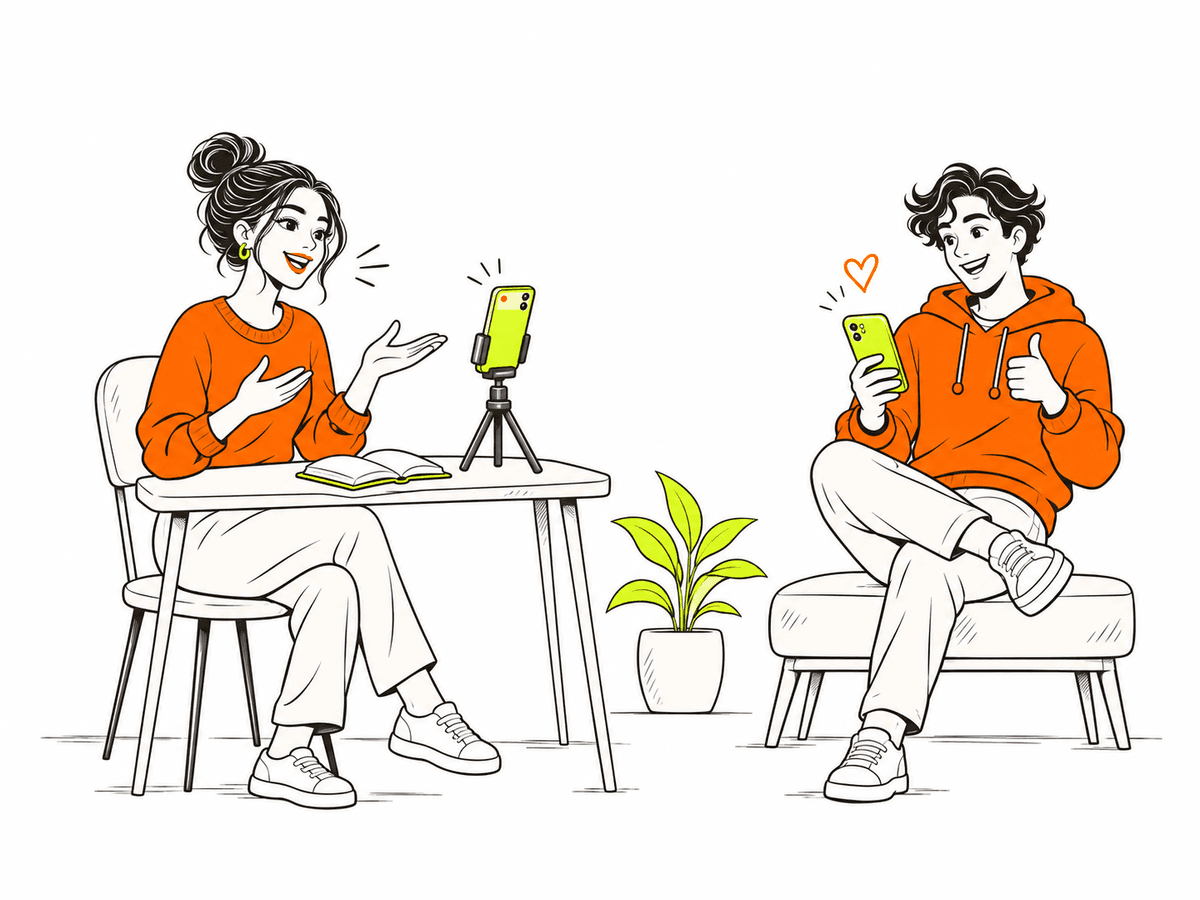
Short dialogues in Telegram, video updates and group support help you return to the language every day and reinforce familiar rules in speech.
What a dialogue day looks like
1. Receive a dialogue in Telegram
The task arrives in the group chat according to the schedule. If audio is enabled for the group, the dialogue comes with a recording you can listen to while preparing.
2. Understand, listen and learn
Work out what the speakers are talking about. Listen to the recording, say the lines aloud and learn the dialogue by heart. Record a video of yourself saying it.
3. Send your video to the group
Your video in the group is your completion report. See how the others did and support them with a message or reaction.
A look at the research
Revisit material on different days. A meta-analysis of second-language studies found benefits from spaced learning; the results depended on the tasks and intervals. In IDVI, a series of dialogues reinforces one grammar focus. Kim and Webb, 2022
Recall from memory. In an experiment with vocabulary pairs, repeated attempts to recall an answer helped retain it in memory. In IDVI, participants learn the lines and try to reproduce them themselves. Karpicke and Roediger, 2008
Explain the rule. A meta-analysis of second-language instruction found benefits from focused instruction, including explicit explanation. Our programme sets aside a separate day for grammar. Norris and Ortega, 2000
Small amounts of new material. A review of cognitive load research explains why the amount of new material and the available support matter in learning. IDVI tasks are built around a limited grammar focus. Sweller, van Merriënboer and Paas, 2019
Track completed steps. A meta-analysis, mainly of health-related goals, found benefits from monitoring progress towards a goal. In IDVI, participants share their completed work with the group. Harkin and colleagues, 2016
The research references here concern individual learning techniques and progress monitoring.
For level objectives, we use the Council of Europe's CEFR descriptors, and for the Spanish programme we also use the Plan curricular Instituto Cervantes.
These studies help us answer some questions
Why learn a dialogue by heart?
You memorise complete phrases and lines. They are easier to recall when preparing your next conversation. You can then change details and add a line of your own to connect a familiar structure with what you want to say.
A dialogue learnt by heart gives you ready-made material for everyday communication. In lessons with a teacher, you learn to use it in a new situation and respond in your own words.
Why return to the same rule for several days?
The programme alternates a brief explanation of a rule with several days of dialogues on the same grammar focus. You explore the structure and use it in everyday situations.
A separate grammar day. Study the rule and examples. Record a video with your own examples, following the day's task.
The following days - dialogues. Meet the familiar structure in different everyday situations, learn the lines and say them yourself.
Then a new focus. Move on to the next structure and keep applying what you have learnt. The sequence of topics builds on what the group already knows.
For example, at the beginning of Spanish A1, you learn to introduce yourself and ask where someone is from. The people and circumstances change in the dialogues, giving the familiar structure a new use.
What can you adjust for your group?
Start with the ready-made settings and launch learning with one button. But if you want to tailor the activities to your group, you can choose:
- The language to learn and the starting level.
- The language of explanations and instructions.
- Learning modules and the starting point.
- Dialogue topics, including your own.
- The pace of the programme.
- Task difficulty.
- The time of the activities and the time zone.
- How often to have rest days.
- Audio recordings of the dialogues.
After completing the programme, the group automatically moves on to the next level. You can also take an optional test to check your knowledge.
For teachers
The programme is already planned, and tasks arrive in the group automatically. You can arrange the modules around your lessons and edit the material when needed.
IDVI is a free supplementary tool for your group. Between lessons, learners study grammar, learn dialogues by heart and record videos. In class, you can discuss their examples and move from a prepared dialogue to a live conversation.
How this approach began
IDVI grew out of a group challenge at work: participants chose small daily actions in sport, personal development or language learning and shared their progress every day. Shared commitments and support helped them keep going.
Working with teachers, exploring existing practices and methods, and our own experience of learning different languages helped us shape the IDVI language-learning format.
The IDVI method combines a group challenge, habit formation and progress towards a big goal through small daily tasks. Participants agree to study every day and show the group what they have done. Their reports reveal who is keeping a steady rhythm, who needs support and which tasks are proving difficult. A shared commitment becomes personal responsibility for regular practice.
We break the big goal of speaking a language into concrete steps: understand a rule, reinforce it in short everyday dialogues and say the lines from memory. A grammar day is followed by several days of practice, then the cycle repeats with a new structure.
The daily task is designed to take 10-15 minutes. A manageable workload helps you fit the language into an ordinary day, while repetition and video updates help you notice your own progress and turn learning into a habit.
Participation in educational technology competitions
IDVI Language has submitted applications to two competitions:
- The Webby Awards - Education: an educational website and digital service for daily language practice.
- World Summit Awards - Learning & Education: a digital solution with social benefits and accessible learning. Applications go through a national selection process.
Published: · Updated:
Reviewed by Roman Demyrov · Learning methodology specialist with a technical education ·